Gray Phantoms of the Cape Fear by Dawson Carr
Author:Dawson Carr
Language: eng
Format: epub
Tags: Civil War / History
ISBN: 9780895874276
Publisher: John F. Blair, Publisher
Published: 1999-02-10T05:00:00+00:00
Meanwhile, in France, the Erlanger Company proposed a loan based on cotton bonds that would provide the Confederacy with $25 million. When Slidell sent the proposal to Secretary Benjamin, the terms were judged to be so glaringly unfair that it was rejected in spite of the South’s desperate need. In pushing for a smaller loan, Benjamin insisted on reducing the outlandish percentage the Erlanger Company was seeking. Finally settling on a loan of $15 million, the South got only a little more than half the proceeds after the Erlanger Company got its cut.
By this time, Huse and other purchasing agents had spent all their money, extended their credit, and run up massive debts with several European companies. At the end of 1862, merchants were showing themselves hesitant to extend further credit until the Confederates paid for goods already received. Mason pleaded with Slidell to see to the release of the Erlanger funds, which were inexplicably still unavailable.
The Erlanger loan, finalized in September 1862, was not released until the summer of 1863. Spence was outspoken in his criticism of the terms of the loan and the delay in the release of the monies. The Erlanger Company was in turn piqued by Spence’s criticisms and made its displeasure known to Slidell and Mason. Slidell wrote Secretary Benjamin denouncing Spence’s tactics and pushing for his removal. Anxious to avoid any interference with the consummation of the loan, Benjamin assigned the responsibility for overseeing the Erlanger deal to C. J. McRae, leaving Spence in charge of transactions in England only. Power over the Erlanger loan gave McRae considerable sway over most Confederate purchases in Europe. Spence was pushed out of power in spite of all the favors he had done for the South.
By the summer of 1863—with the Erlanger loan approved, cotton certificates and treasury bonds available, and companies prepared to sell almost anything the Rebels needed—the South was ready to supply its war efforts.
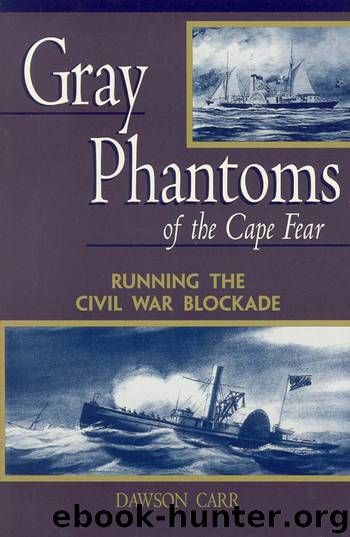
Many of the companies that ran the blockade were British owned, and it was natural for them to look for their fleets of runners among their own ships. They found what they were seeking in the boats that plied the rivers of England and Scotland. There was an existing force of medium-sized steamers that were fleet, had a shallow draft, and were designed for the short voyages between ports along the Clyde River. Most of them were sidewheelers ideal for slipping across the treacherous sand bars of the Carolina coast. Very quickly, almost all such steamers began to disappear from the Clyde River.
These “off the shelf” vessels were too unstable for ocean voyages from England to the South. But they were excellent for the three- and four-day jaunts between Wilmington and the island ports; more than fifty of them were making the trip by 1863. Their biggest drawbacks were their limited coal and cargo capacities. Since the vessels were designed for ferrying passengers or transporting small loads, they were capable of storing only 100 to 200 tons of coal. A
Download
This site does not store any files on its server. We only index and link to content provided by other sites. Please contact the content providers to delete copyright contents if any and email us, we'll remove relevant links or contents immediately.
| Africa | Americas |
| Arctic & Antarctica | Asia |
| Australia & Oceania | Europe |
| Middle East | Russia |
| United States | World |
| Ancient Civilizations | Military |
| Historical Study & Educational Resources |
Cat's cradle by Kurt Vonnegut(15353)
Pimp by Iceberg Slim(14506)
4 3 2 1: A Novel by Paul Auster(12392)
Underground: A Human History of the Worlds Beneath Our Feet by Will Hunt(12097)
The Radium Girls by Kate Moore(12028)
Wiseguy by Nicholas Pileggi(5784)
The Fire Next Time by James Baldwin(5444)
Perfect Rhythm by Jae(5403)
American History Stories, Volume III (Yesterday's Classics) by Pratt Mara L(5307)
Paper Towns by Green John(5190)
Pale Blue Dot by Carl Sagan(5007)
A Higher Loyalty: Truth, Lies, and Leadership by James Comey(4962)
The Mayflower and the Pilgrims' New World by Nathaniel Philbrick(4502)
The Doomsday Machine by Daniel Ellsberg(4490)
Killers of the Flower Moon: The Osage Murders and the Birth of the FBI by David Grann(4447)
The Sympathizer by Viet Thanh Nguyen(4390)
Too Much and Not the Mood by Durga Chew-Bose(4348)
The Borden Murders by Sarah Miller(4325)
Sticky Fingers by Joe Hagan(4198)
